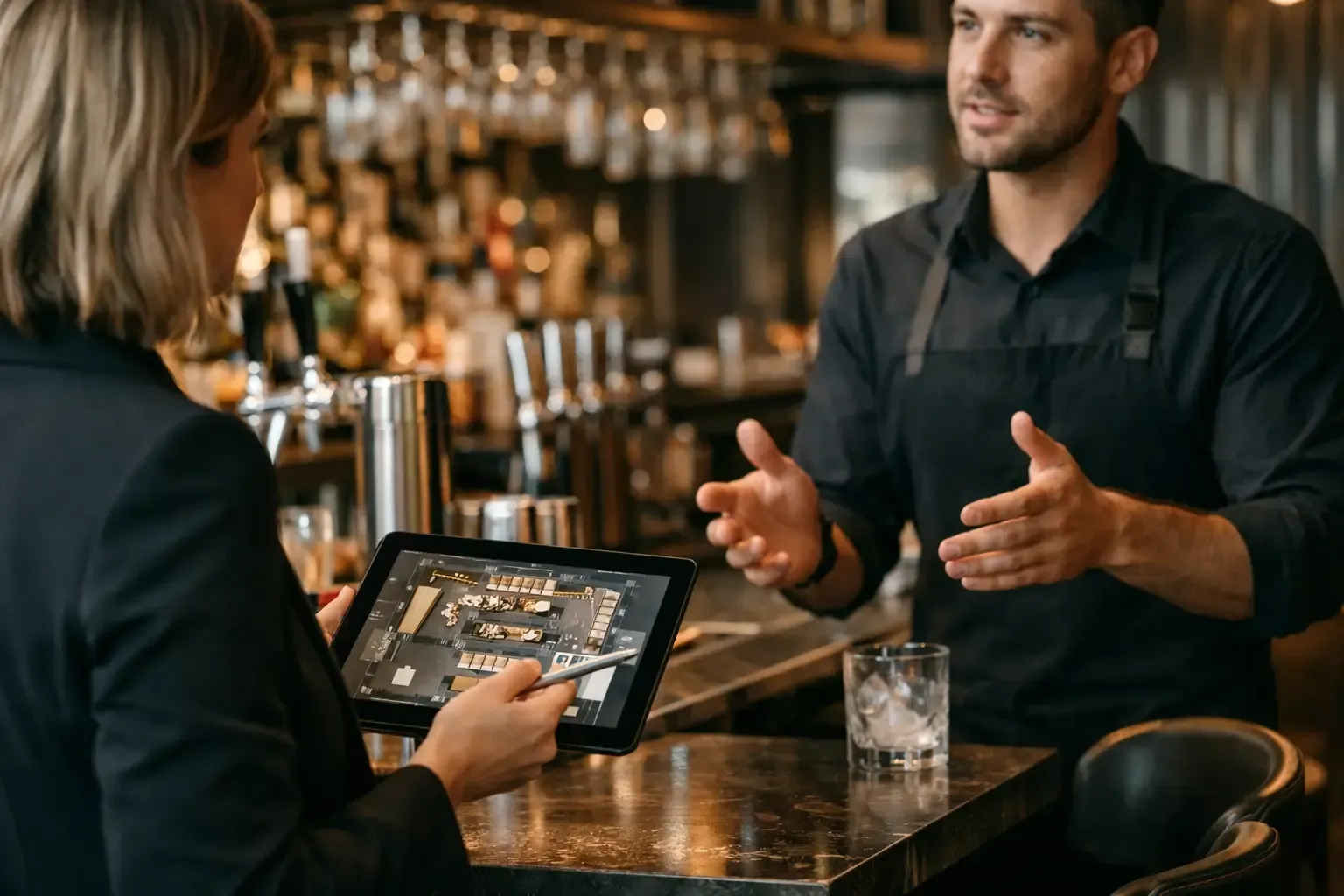
A crowded Friday night tells the truth fast. If bartenders are crossing paths, glassware is backing up, tickets are stalling, and guests are waiting too long for a simple round, the problem is not always the staff. Very often, it is the room. A bar layout design consultant looks at the physical setup through an operator’s lens and fixes the hidden design choices that slow service, raise labor costs, and cap revenue.
That matters because bar performance is shaped long before the first shift starts. Equipment placement, ice access, POS location, reach paths, sink count, underbar storage, service well design, and guest pickup points all affect how quickly drinks get made and how consistently the team can execute. When the layout is wrong, even a strong crew will struggle. When it is right, speed improves, waste drops, and the bar becomes easier to manage under pressure.
What a bar layout design consultant actually does
This is not interior decorating. It is operational planning with financial consequences.
A strong consultant studies how the bar needs to function during real service, not how it looks on a rendering. That means reviewing projected volume, menu mix, staffing model, dayparts, check averages, and service style. A cocktail-forward lounge, a hotel lobby bar, a nightclub, and a casual restaurant bar should not be built the same way because they do not produce revenue the same way.
The best work starts with core questions. How many bartenders need to work the space at peak? Is the bar serving seated guests, table service, or both? Will the team be shaking and stirring craft drinks, opening beer and wine at speed, or handling frozen beverages and coffee in the same footprint? Every answer changes the layout.
A bar layout design consultant then translates those operating realities into a physical plan. The goal is simple - reduce wasted motion, protect throughput, support quality, and make the bar profitable to run.
Why layout mistakes get expensive fast
Most operators feel a bad layout before they can fully diagnose it. Labor runs hot, ticket times creep up, staff frustration grows, and management starts treating symptoms instead of the cause.
One common issue is overbuilding for appearance and underbuilding for function. A long, visually impressive bar can still fail if the service wells are too narrow, refrigeration is in the wrong place, or garnish storage forces repeated steps. Another mistake is trying to save money upfront by trimming equipment or utility planning, only to pay for it later in slower production and retrofit costs.
There is also a sales impact. If bartenders cannot produce at peak speed, the business leaves money on the bar top. That loss is easy to underestimate. A few seconds added to every drink, multiplied across a busy service, becomes a meaningful revenue ceiling. The room may be full, but the bar is still underperforming.
For new concepts, these errors are hardest to unwind after construction. For existing venues, redesign decisions have to balance disruption, budget, and return. That is where experienced guidance matters. Good design is not about perfection on paper. It is about making the best operational decision within the constraints of the site.
The core areas a consultant evaluates
The first area is bartender movement. Every extra pivot, reach, and step has a cost. A well-planned station groups the most-used tools and ingredients within easy reach and separates production tasks cleanly enough that two or three bartenders can work without interference.
The second is service flow. Guest-facing service and server ticket production create different demands, and many bars fail because they force both through the same choke point. A consultant will look closely at whether the service well is positioned properly, whether pickup interrupts production, and whether bar guests are competing with servers for attention in a way that hurts both experiences.
The third is storage and replenishment. It is not enough to hold product. The layout has to support fast restocking during live service. That includes liquor, wine, beer, mixers, glassware, ice, garnishes, and disposables if the concept uses them. If the team has to leave the station too often, speed breaks down and labor inefficiency follows.
The fourth is code, utilities, and compliance. A smart layout has to work operationally and pass inspection. Drain lines, dump sinks, hand sinks, refrigeration clearances, electrical loads, and local health department expectations all affect what is realistic. A consultant with operating and opening experience will catch issues before they become delays.
Bar layout design consultant work is part operations, part math
This is where many design conversations improve. Operators do not need a prettier sketch. They need a bar that supports the business model.
That means connecting layout decisions to numbers. How many covers does the concept expect at peak? What percentage of sales should come from beverage? How many bartenders are scheduled by daypart? What is the target labor percentage? If a better service well design allows one bartender to handle more volume without sacrificing standards, that has a measurable financial impact.
It also means making trade-offs on purpose. A larger back bar display may help visual merchandising, but if it reduces practical refrigerated storage, the sales lift may not justify the operational drag. A wide guest bar top may improve comfort, but if it compresses the working depth behind the stick, it may hurt production all night. Good consulting is about understanding which compromises support profit and which ones quietly erode it.
New builds and remodels need different advice
For a new build, the window to make smart decisions is early. Once architectural plans are moving, every late change gets more expensive. The consultant’s role is to coordinate bar function before inefficiencies get poured into concrete, millwork, plumbing, and electrical.
For a remodel, the challenge is usually constraint. Existing columns, drains, hood paths, and wall lines may limit the ideal solution. In those cases, the best consultant does not chase a fantasy layout. They improve the actual site. Sometimes that means redesigning one station, shifting the POS, reworking ice and glass flow, or changing the service model instead of rebuilding the entire bar.
That operator mindset is what separates practical consulting from theoretical advice. The goal is not to win a design award. The goal is to make the bar perform better in the real world.
When to bring in a bar layout design consultant
If you are opening a new concept, the answer is early. Before equipment orders are locked, before millwork is finalized, and before the field starts solving design gaps with costly improvisation.
If you are already open, bring one in when the signs are clear. Bartenders are colliding at peak. Server tickets stack despite strong staffing. Guests wait too long for simple drinks. Managers keep adjusting labor but results do not improve. Productive staff complain about the setup. These are layout signals, not just performance issues.
Multi-unit operators should also look at consistency. A repeatable, high-functioning bar model makes training easier, controls labor better, and reduces opening risk across locations. Standardization does not mean every unit looks identical. It means the critical workflow decisions are intentional and scalable.
What to look for in the right consultant
Experience matters, but relevant experience matters more. A consultant who has actually run high-volume beverage operations will ask better questions than someone focused only on drawings. They will understand prep burden, glass pars, station turnover, staffing stress, and what happens when the room goes from quiet to slammed in ten minutes.
Look for someone who can speak both operations and buildout. They should be able to discuss throughput, menu engineering, and labor efficiency just as comfortably as underbar equipment, storage logic, utility requirements, and compliance risk. That combination helps keep the project grounded.
It also helps to work with a team that understands the full business picture. At Step It Up Strategies, that operator-led approach matters because bar layout is never just a design exercise. It affects service, payroll, training, beverage sales, guest satisfaction, and long-term profitability.
The right consultant will not promise a one-size-fits-all solution. They will tell you where the layout needs to be tighter, where you may be overbuilding, and where spending more upfront could save you later. That honesty is usually worth more than a polished presentation.
A bar should not fight the team that runs it. When the layout supports the menu, the volume, and the service model, the room gets faster, cleaner, and more profitable. That is not a cosmetic improvement. It is operational leverage, and it pays back every shift.