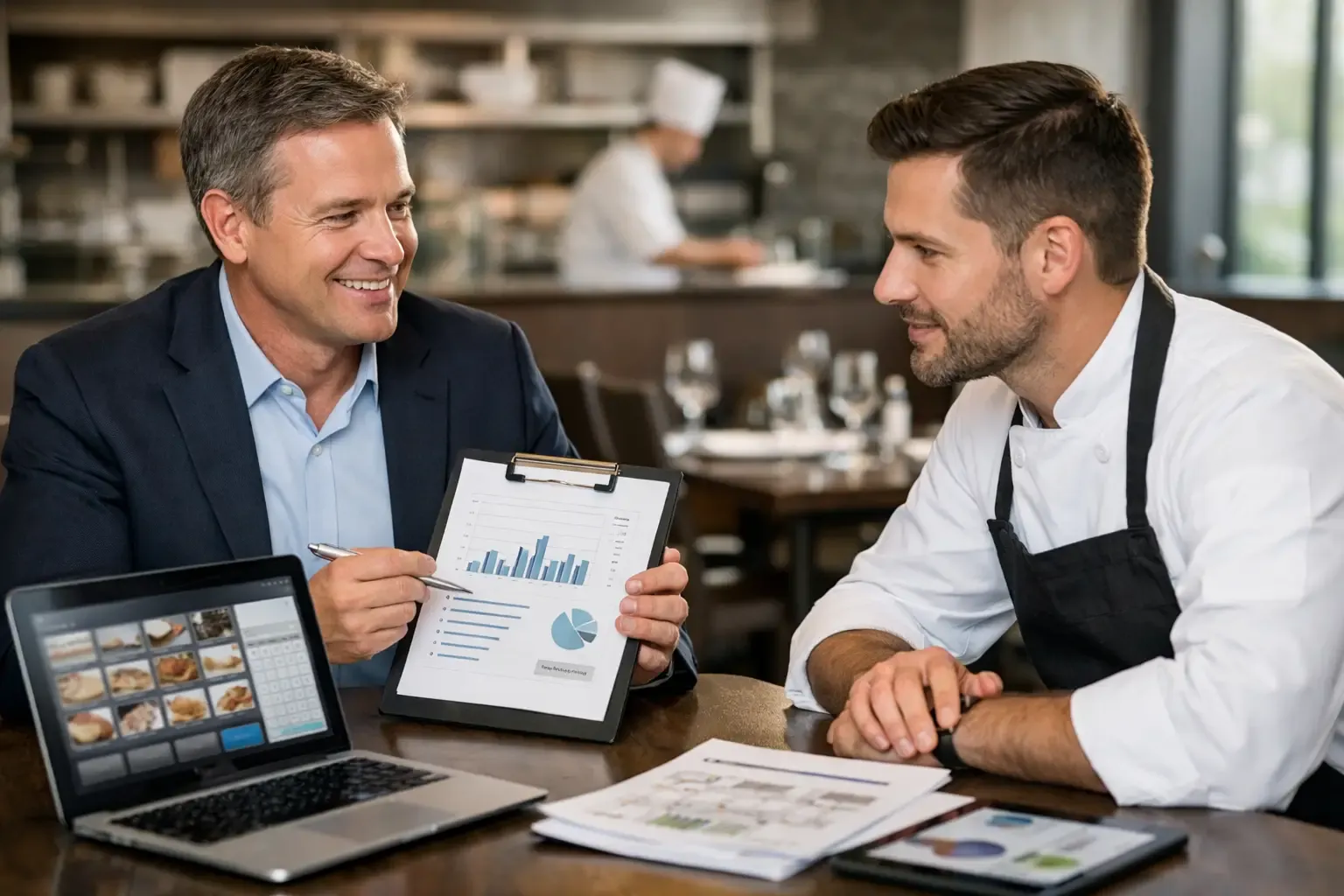
A restaurant can look busy, serve good food, and still lose money every week. The warning signs are familiar: managers spend their shifts putting out fires, food cost moves without explanation, labor rises despite flat sales, and guest complaints repeat because nobody owns the fix. A restaurant systems consultant is brought in to find the operating gaps behind those symptoms and build a way of working that holds up during a real Friday night.
That distinction matters. A system is not a binder full of procedures that sits in an office. It is the practical connection between standards, people, reporting, and follow-through. It tells a line cook what portion is correct, gives a manager a way to verify it, shows the owner when the result moves off target, and establishes what happens next.
What Restaurant Systems Actually Control
Restaurant systems exist to make performance repeatable. They cover how product is ordered, received, stored, prepped, produced, sold, counted, and reconciled. They also govern how employees are hired, trained, scheduled, coached, and held accountable. On the guest side, they shape reservation flow, order accuracy, ticket times, recovery procedures, and the consistency of the experience from one shift to the next.
Most operators do not need more rules. They need fewer rules that are clear, measurable, and used consistently. A complicated inventory process that no one completes is worse than a disciplined weekly count focused on high-value, high-variance items. A 70-page training manual does not help if new servers never practice the steps that prevent order errors and protect check averages.
The right level of structure depends on the business. A 20-seat chef-driven restaurant should not operate like a 12-unit fast-casual group. But both need clear opening and closing accountability, cost controls, manager handoffs, and financial reporting that arrives early enough to influence decisions.
Where a Restaurant Systems Consultant Starts
Good consulting does not begin with a generic checklist. It begins on the floor, in the kitchen, and inside the numbers. The consultant should watch how a shift actually runs before prescribing how it should run. What employees say the process is and what happens at 7:30 p.m. are often two different things.
The first review usually connects operational observations with financial evidence. If prime cost is high, the issue may be pricing, purchasing, waste, overtime, scheduling, theft, poor execution, or several of those at once. If sales are strong but cash is tight, the problem may be weak payables management, excessive inventory, uncontrolled comps, or a reporting process that leaves ownership reacting weeks too late.
A serious assessment examines the handoffs where profit commonly disappears: vendor ordering to receiving, receiving to storage, storage to prep, prep to production, production to the guest, and the guest check to daily reporting. It also examines management handoffs. If one manager knows how to close correctly but the next person does it differently, the operation does not have a system. It has a dependency.
Financial visibility comes before broad cost cutting
When margins are under pressure, many operators start by cutting hours or buying cheaper product. Those moves can be necessary, but they are blunt instruments. Cutting labor without fixing deployment can damage service, reduce sales, and create more turnover. Buying cheaper product without recipe and yield discipline can create a guest-quality problem without solving food cost.
A better first move is establishing a reliable operating baseline. That means a usable chart of accounts, timely weekly sales and labor reporting, recipe costs that reflect current vendor pricing, and inventory procedures that produce credible variance information. Management cannot correct what it cannot see.
The goal is not reporting for its own sake. The goal is to give leaders a short list of decisions they can make before another month is lost. For example, an operator may find that weekend bar labor is correctly staffed but weekday opening labor is not. Or that food cost is acceptable in aggregate while one high-volume menu item is being overportioned at a single location.
Service systems protect revenue, not just standards
Speed of service is often treated as a front-of-house issue. It is usually a cross-functional issue. Slow ticket times may stem from poor station setup, unclear expo authority, an overloaded menu, inconsistent prep, late table turns, or a host stand that seats the dining room in waves.
The fix needs to match the constraint. Adding a cook may help, but it can also increase labor while leaving the actual bottleneck untouched. Reworking the order of operations, reducing unnecessary modifiers, changing a prep par, or assigning one person clear expo ownership can be more effective.
Guest recovery requires the same discipline. If a table receives a poor experience, staff should know who has authority to act, what can be offered, how the incident is documented, and when management follows up. Empowerment without guardrails becomes inconsistent comping. Guardrails without empowerment leave guests waiting for a manager while the frustration grows.
The Systems That Usually Need Attention First
Priorities should follow risk and financial impact, not personal preference. In most independent and multi-unit operations, the first wave of work centers on four areas:
- Daily sales, cash, discount, void, and comp controls that make every shift reconcilable.
- Purchasing, receiving, invoice review, and inventory routines that expose price movement, waste, and product loss.
- Labor forecasting, scheduling, deployment, and manager productivity standards tied to actual demand.
- Recipe, portion, prep, and menu-engineering controls that protect contribution margin while maintaining the guest experience.
These areas connect. A recipe cost that is never updated leads to misleading menu decisions. Weak receiving allows invoice discrepancies and quantity errors to enter the building. Poor scheduling creates rushed prep and service failures. Missing daily close controls make it harder to determine whether losses came from operations, cash handling, or reporting.
That is why software alone is rarely the answer. A new POS, inventory platform, or scheduling app can improve visibility, but only when roles, data ownership, and operating routines are defined. Technology should reduce friction and improve accountability. It cannot replace management presence or sound judgment.
Building Systems People Will Actually Use
The implementation phase is where many improvement projects fail. Owners approve new standards, managers attend a meeting, and the operation returns to old habits by the next busy weekend. The failure is not usually resistance alone. It is often that the new process was too theoretical, poorly introduced, or never reinforced.
Practical implementation starts with the people responsible for the work. A receiving procedure should be tested with the manager receiving a delivery at 9 a.m., not explained only in a conference room. A closing checklist should be built around the actual close, including the point at which drawers are counted, deposits are verified, equipment is checked, and exceptions are reported.
Training should answer three questions: What does good look like? How is it measured? What happens when the standard is missed? Employees deserve clarity, particularly when the standard affects compensation, scheduling, advancement, or discipline. Managers need the authority and the time to inspect the work, not just the responsibility to answer for results.
Documentation matters, but it should serve execution. A concise station guide with photos, pars, and quality standards may be more useful than a long manual. A manager scorecard with five meaningful metrics is more likely to drive action than a dashboard with 40 figures nobody reviews.
When Outside Support Is Worth It
A restaurant systems consultant is most valuable when the business has outgrown informal management, is preparing to open or expand, or has reached a point where the owner is still the only person who can make the operation function correctly. Outside support can also be warranted when the numbers and the floor tell conflicting stories, when turnover is accelerating, or when a turnaround needs more speed and discipline than the existing team can provide.
The best consultant does not arrive with a prepackaged playbook and disappear after a presentation. They ask hard questions, work from verified information, and help leadership make trade-offs. A labor target that works on paper may not work for a late-night concept with complex security, cleaning, and guest-management needs. A menu reduction may improve execution but remove a signature item that drives repeat business. Decisions should be grounded in the concept, its market, and its operating reality.
Step It Up Strategies approaches this work as operators who understand that a standard is only valuable when it can survive staffing shortages, vendor delays, rush periods, and demanding guests. The objective is not to make the business look organized. It is to make the business more controllable, more profitable, and easier to lead.
A well-run restaurant is not one where nothing goes wrong. It is one where the team sees problems early, knows who owns the response, and has a disciplined way to correct course before a small miss becomes an expensive pattern.