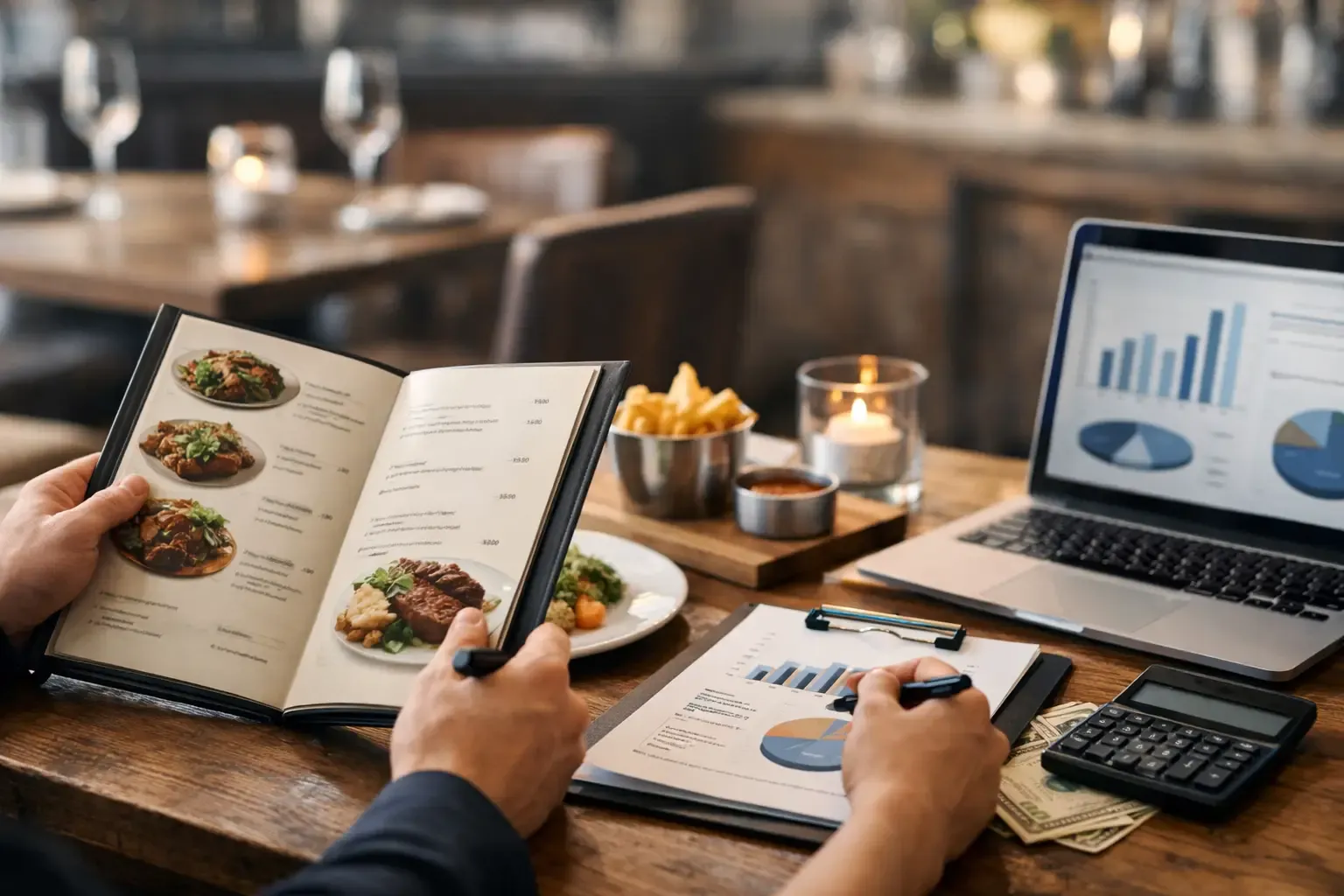
A busy dining room can hide a weak menu. If sales are up but cash is still tight, the problem is often not traffic - it is what guests are buying, how those items are built, and whether the price reflects the total cost to deliver them. A restaurant menu profitability audit replaces assumptions with operating facts, giving ownership a clear view of which menu items deserve more attention, a redesign, a price adjustment, or removal.
This is not an exercise in cutting the highest-cost entrée. A signature item may carry a lower food-cost percentage and still produce strong dollars per plate, repeat visits, and check growth. The job is to understand the whole economic picture before making decisions that frustrate guests or damage the concept.
Start With Contribution Margin, Not Food Cost Percentage
Food-cost percentage has a place in menu management, but it is often misused. A $14 item with a 25% food cost generates $10.50 before labor and operating expenses. A $32 item with a 35% food cost generates $20.80. The second item has a higher food-cost percentage, yet it contributes nearly twice as many dollars toward payroll, occupancy, and profit.
A menu profitability audit starts by calculating contribution margin for every item: selling price less the current plate cost. That calculation must be built from current vendor invoices, not a recipe cost from six months ago. Beef, seafood, dairy, cooking oil, specialty produce, and imported products can move quickly enough to turn a previously reliable item into a margin problem.
Recipe costing also has to reflect how the kitchen actually works. Include every component: garnish, sauce, fryer oil allocation where appropriate, bread service, disposables for takeout, and the portion of prep that reaches the plate. A cost card that ignores a two-ounce overpour, an unrecorded ramekin of sauce, or a generous handful of cheese is not a cost card. It is a wish.
Pair Profitability With Sales Mix
Margin alone does not tell an operator what to do. The next question is popularity. Pull a clean period of point-of-sale data, usually 8 to 13 weeks, and calculate each item's share of category sales. Then compare its sales mix against its contribution margin.
That produces four useful operating categories. High-margin, high-volume items are the menu's workhorses. Protect their execution, feature them intelligently, and confirm that prep capacity can support demand during peak periods. High-margin, low-volume items may be under-merchandised, buried in the menu, poorly named, or difficult for the service team to describe.
Low-margin, high-volume items need immediate attention because small changes have an outsized impact. A $1 improvement on an item that sells 1,500 times a month is $18,000 in annual contribution margin before considering sales growth. Low-margin, low-volume items are candidates for a serious conversation. They may be there for brand credibility or menu balance, but they should not remain simply because they have always been there.
This is where judgment matters. A raw bar, a premium steak, or a chef-driven seasonal dish may have strategic value beyond its direct margin. It can establish the price ceiling, attract a particular guest, or support beverage sales. Keep it if it earns its place. Just make that decision intentionally and measure the supporting revenue rather than calling it a loss leader by default.
Audit the Cost of Complexity
A profitable item can become operationally expensive if it adds too much friction to the line. Menu complexity shows up in labor hours, ticket times, waste, inventory counts, storage needs, and training failures. Those costs rarely appear on a standard recipe card, but operators feel them every Friday night.
Review every item through the lens of production. Does it require a unique ingredient used nowhere else? Does it demand a station setup that slows other tickets? Is a time-consuming garnish adding value guests recognize? Does the item create frequent modifiers or remakes? A dish that contributes $16 on paper may be a poor performer if it consumes five minutes of constrained grill capacity during the busiest hour.
Look closely at ingredient cross-utilization. A focused menu can still offer variety when proteins, sauces, produce, and prep components work across multiple dishes. Cross-utilization lowers dead inventory, makes purchasing more predictable, and allows prep teams to execute consistently. The trade-off is that excessive overlap can make a menu feel repetitive. The goal is not to make every dish taste the same. It is to eliminate wasteful one-off purchasing and unnecessary production steps.
Validate Portions and Yield in the Kitchen
Theoretical food cost and actual food cost should tell a similar story. When they do not, the issue is usually portion control, receiving, waste, theft, invoice errors, or outdated recipes. No menu pricing strategy can solve a kitchen that is consistently serving more product than the recipe allows.
A disciplined audit includes line observations and yield testing. Weigh proteins before and after trimming and cooking. Verify scoop sizes, ladle volumes, pour counts, cheese portions, and plating standards. Observe multiple cooks, on multiple shifts. The best-trained day crew is not the benchmark if the late-night team is building every burger differently.
Portion reductions should be handled carefully. Guests notice when value disappears, especially on center-of-the-plate proteins. Often, the better move is to protect the core portion while tightening inconsistent components, improving the plate's visual architecture, or offering an add-on that lets guests choose a larger experience. If a portion change is necessary, test it in service and train the team on the reason behind it. A change that servers cannot explain becomes a guest complaint.
Price With the Market, the Experience, and the Math
Pricing cannot be based solely on a target food-cost percentage. Your competitive set, location, service model, check average, guest demographics, and perceived value all matter. A full-service restaurant in a high-rent district has different pricing requirements than a counter-service concept with a limited labor model, even if both sell a similar chicken entrée.
Start with the contribution margin required to support the business. Then compare the item to local competitors and assess the guest experience around it. Is the presentation strong? Is the portion appropriate? Does the service team have a credible story to tell? Is the item bundled with premium sides, table service, or a distinctive environment? Price increases are easier to sustain when the experience makes the price feel earned.
Do not assume every correction requires a broad menu increase. Targeted changes are usually more effective. Raise prices where demand is durable and the item remains competitive. Rebuild items with inflated costs. Move costly modifiers to paid add-ons. Reposition a premium item within the menu. In some cases, removing a weak item will improve profitability more than raising the price on it.
Treat Menu Design as a Sales Tool
Once the numbers are correct, the menu needs to direct demand toward the right choices. A high-margin dish cannot help the business if guests cannot find it, understand it, or order it with confidence.
Review item names, descriptions, category placement, and visual hierarchy. Descriptions should sell the experience while answering practical questions about the product. They should not be so long that they slow ordering or create unrealistic expectations. Servers and bartenders also need concise talking points for the items the operation wants to grow. A pre-shift that focuses only on the newest feature misses the opportunity to improve the everyday sales mix.
Beverage deserves equal scrutiny. A thoughtful wine, beer, cocktail, and nonalcoholic program can materially improve check average and margin, but only if pours are controlled, recipes are current, and inventory is managed. Audit beverage items by contribution dollars, velocity, pour cost, and the labor required to produce them. A labor-heavy cocktail may justify its place in a high-energy bar program. It may not make sense at a lunch-focused restaurant where speed is the primary guest expectation.
Turn Findings Into an Operating Plan
The audit has failed if it ends as a spreadsheet. Convert findings into a short action plan with owners, deadlines, and measurable targets. Update recipe cards and POS buttons before rolling out a price change. Retrain the kitchen before enforcing new portions. Notify purchasing when an item is removed so discontinued ingredients do not keep arriving. Give managers a weekly report that tracks sales mix, contribution margin, actual food cost, waste, and exceptions.
Revisit the menu on a set cadence. A quarterly review works for many stable concepts, while fast-moving operators may need monthly checks on key categories. Conduct a full review whenever vendor pricing shifts materially, labor conditions change, a new menu launches, or actual food cost drifts away from the model.
The strongest menus are not the ones with the fewest ingredients or the highest prices. They are the ones built to deliver a consistent guest experience while producing enough contribution margin to fund great people, disciplined operations, and growth. That is the standard worth managing to.