Saturday at 7:15 is where weak systems get exposed. You can have a full book, a solid menu, and a dining room packed with demand, but if guests sit too long waiting to order, food drags, checks stall, or bussing falls behind, revenue gets trapped at the table. That is the real question behind how to improve table turnover: not how to rush guests out, but how to remove the operational drag that keeps seats from producing.
For most operators, table turnover is a throughput issue disguised as a hospitality issue. Guests do not experience it as "turns." They experience it as pacing, attentiveness, comfort, and momentum. If the meal feels organized, they move naturally through it. If the operation hesitates at any point, the table stops generating revenue while labor and occupancy costs keep running.
How to improve table turnover starts with timing, not pressure
The fastest way to damage a good dining room is to treat turnover like a script for pushing people out. Guests can feel that immediately, and they punish it with lower check averages, worse reviews, and fewer repeat visits. Better turnover comes from compressing dead time, not compressing the guest experience.
Look closely at the minutes that add no value. The gap between seating and first greet. The delay before drink orders hit the bar. The window where entrees are finished but nobody clears. The ten-minute wait for a check that should have landed two minutes after dessert was declined. Those are operational leaks.
If you want a reliable improvement, break the meal into stages and measure the real dwell time in each one. In many restaurants, management knows average ticket and labor percentage down to the decimal but cannot answer a simple question: how long does a two-top take from seat to close on a Friday night versus a Tuesday lunch? Until that is visible, turnover is guesswork.
Map the full table cycle before you change anything
A table is not turned when the check is printed. It is turned when the table is reset and ready to seat again. Operators who ignore the reset phase usually overestimate capacity.
Start with five timestamps: seated, greeted, drinks delivered, food delivered, check presented, and table reset. You do not need an elaborate system to begin. A manual sample across a few shifts can show where the bottleneck lives. Sometimes the kitchen is the problem. Sometimes it is host stand pacing. Sometimes it is that servers are carrying too many tables and greeting late.
This matters because the fix depends on the bottleneck. If entrees are taking 23 minutes because the line is buried, coaching servers to move faster does nothing. If food is landing on time but guests wait 12 minutes for payment, the issue is floor management and close-out habits, not production.
The host stand controls more turnover than most operators admit
A bad door strategy can wreck table efficiency even when the kitchen and service team perform well. Seating too many tables at once creates ticket spikes, delays first greet times, and slows the entire room. Under-seating out of caution leaves money on the floor.
The host stand should be paced against kitchen capacity, server readiness, and table mix. That means understanding not just how many seats are open, but which seats are useful at that moment. Filling every four-top with two guests at peak demand may feel like full occupancy, but it can crush covers and reduce sales per hour.
Reservation spacing matters here. If your booking pattern stacks too many arrivals on the quarter hour, the room gets hit in waves. Better pacing often means adjusting reservation intervals, holding a small amount of inventory for walk-ins if the concept depends on them, and coaching hosts to manage quote times with discipline instead of optimism.
Menu design affects turn time more than operators think
If you want to know how to improve table turnover in a sustainable way, review the menu like an operations document, not just a sales tool. Some menus slow the room down by design. Too many modifiers, too many courses that require hand-holding, or a long list of dishes with uneven pickup times can bottleneck both ordering and production.
That does not mean stripping the concept of personality. It means making sure the menu supports your business model. If your peak periods depend on two turns between 6:00 and 9:00, but your menu encourages long indecisive ordering and highly variable cook times, your operating model and guest journey are fighting each other.
Tightening descriptions, reducing unnecessary modifiers, steering guests toward high-margin items that can be executed quickly, and creating clear category logic can speed decisions without making the menu feel limited. Beverage programs matter too. Cocktails that take too long during volume can slow first-round delivery and delay the table's entire progression.
Service steps need precision, not more effort
Most turnover problems are not caused by lazy teams. They are caused by vague standards. "Be attentive" is not a standard. "Greet within 60 seconds, fire appetizers within two minutes of order entry, pre-bus continuously, and present the check within two minutes of dessert decline" is a standard.
Servers need clear expectations for pacing every stage of the meal. So do bussers, food runners, bartenders, and hosts. If nobody owns the transition between one stage and the next, tables sit in neutral.
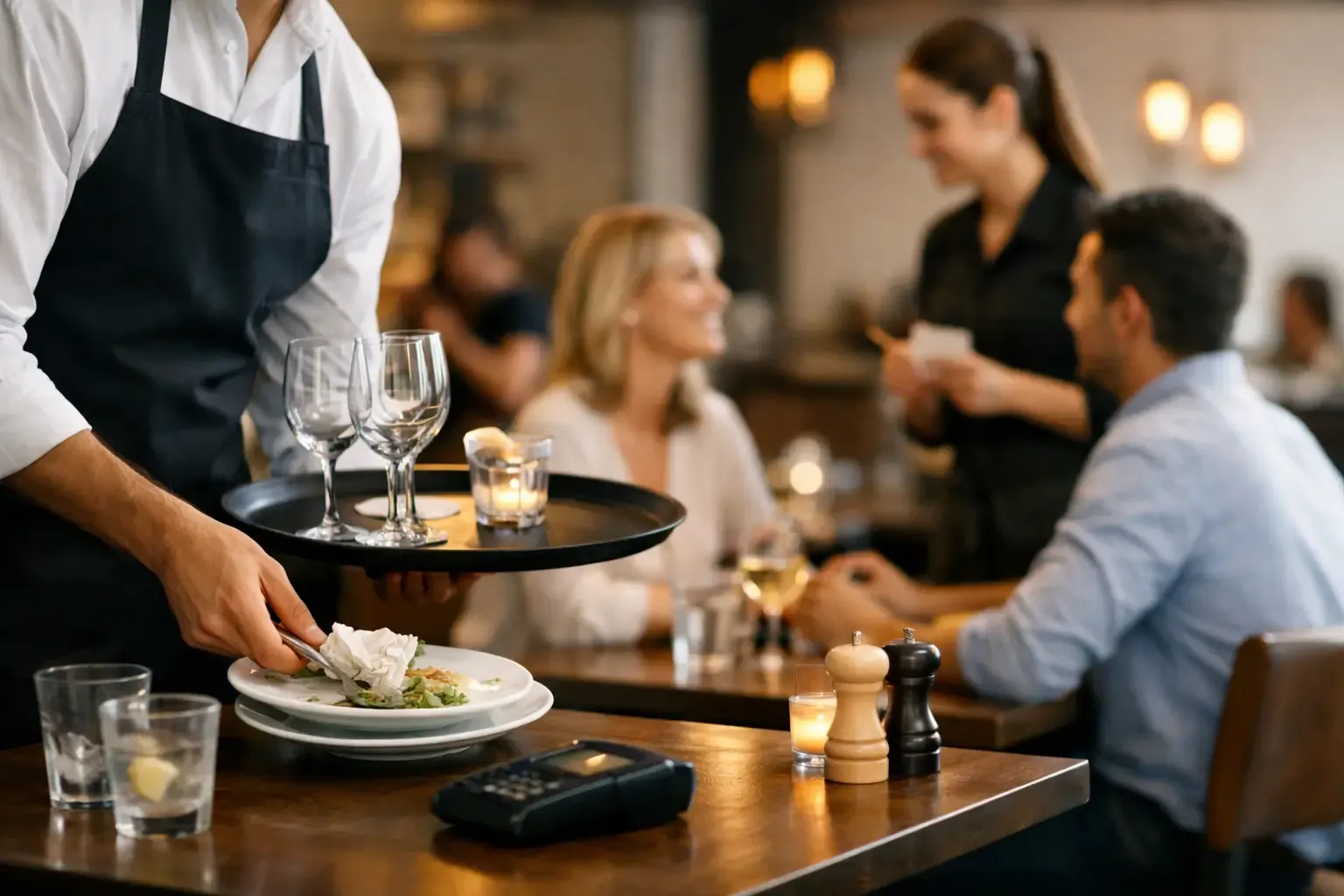
Pre-bussing is one of the easiest examples. In too many dining rooms, dirty plates stay on the table until the course is fully finished and the server has a spare moment. That creates visual clutter, slows guest momentum, and delays dessert or check presentation. Teams that pre-bus consistently keep the meal moving without making guests feel hurried.
Payment is another common failure point. If guests are ready to leave but cannot close out quickly, you are extending occupancy for no reason. Handheld payment, disciplined check-drop timing, and clear ownership of cash-out speed can shave meaningful minutes off every table.
Staffing levels and station design shape your ceiling
There is a point where turnover slows because the room is understaffed, and there is a different point where it slows because the floor plan is inefficient. Operators need to know which one they are dealing with.
If servers are carrying too many seats, greet times stretch, upselling disappears, and table maintenance drops. If support staff is too thin, resets lag and tables sit empty while demand waits at the door. On the other hand, throwing labor at the problem without fixing station design can just raise costs while chaos stays in place.
Watch the travel paths. If bussers are crossing the room repeatedly for glassware, if servers have to backtrack to terminals, or if expo is too far from the main floor, the building is stealing time from every turn. In high-volume environments, seconds matter. Layout, side station placement, and clear traffic flow can increase effective capacity without adding seats.
This is where experienced operators separate themselves from spreadsheet-only advice. The right answer is rarely just "add labor" or "train harder." It is usually a mix of labor deployment, physical layout, and service model alignment.
Use different turnover targets for different dayparts
One mistake we see often is applying one turnover standard across the whole week. Lunch, happy hour, dinner, and late night are different businesses. Guest intent changes. Check averages change. So should pacing.
At lunch, speed may be the value proposition. At dinner, especially in polished casual or fine dining, some dwell time is part of the brand. Trying to force dinner tables into lunch timing can hurt guest satisfaction and alcohol sales. Letting lunch drift into a full-service dinner pace leaves money behind.
Set targets by daypart, table size, and concept type. A fast casual restaurant with limited seating should think very differently about turn times than a steakhouse selling bottles of wine. Improvement only counts if it protects the economics of the concept.
Technology helps, but only if the process is already sound
Operators often look for a tech fix when the real issue is process discipline. Waitlist tools, reservation systems, handheld POS, kitchen display systems, and table management dashboards can all help. But bad habits move through expensive systems just as easily as paper ones.
Use technology to tighten visibility and accountability. It should help the team see where tables are stuck, manage seating cadence, speed payment, and track actual turn times by shift. It should not become a substitute for floor leadership.
Managers still need to work the room, read the bottleneck live, and adjust. A dashboard can show that turns are slipping. It cannot greet a table, run food, or reset a six-top before the next reservation arrives.
How to improve table turnover without hurting hospitality
The test is simple. If turnover improves and guest sentiment drops, you did not solve the problem. You shifted it. The best operators increase turns by making the experience cleaner, faster, and more intentional.
That usually means smaller operational changes executed consistently: better reservation pacing, tighter menu engineering, stronger pre-bussing, faster payment, cleaner handoffs, and dining room layouts built for movement. None of that is glamorous. All of it works.
At Step It Up Strategies, we look at table turnover the way operators should - as a profit, labor, and guest experience equation. More covers only matter if the system can carry them without breaking service or margins.
If your dining room feels busy but sales are not matching demand, the answer is probably sitting in the minutes between one service step and the next. Fix those minutes, and the tables usually take care of themselves.