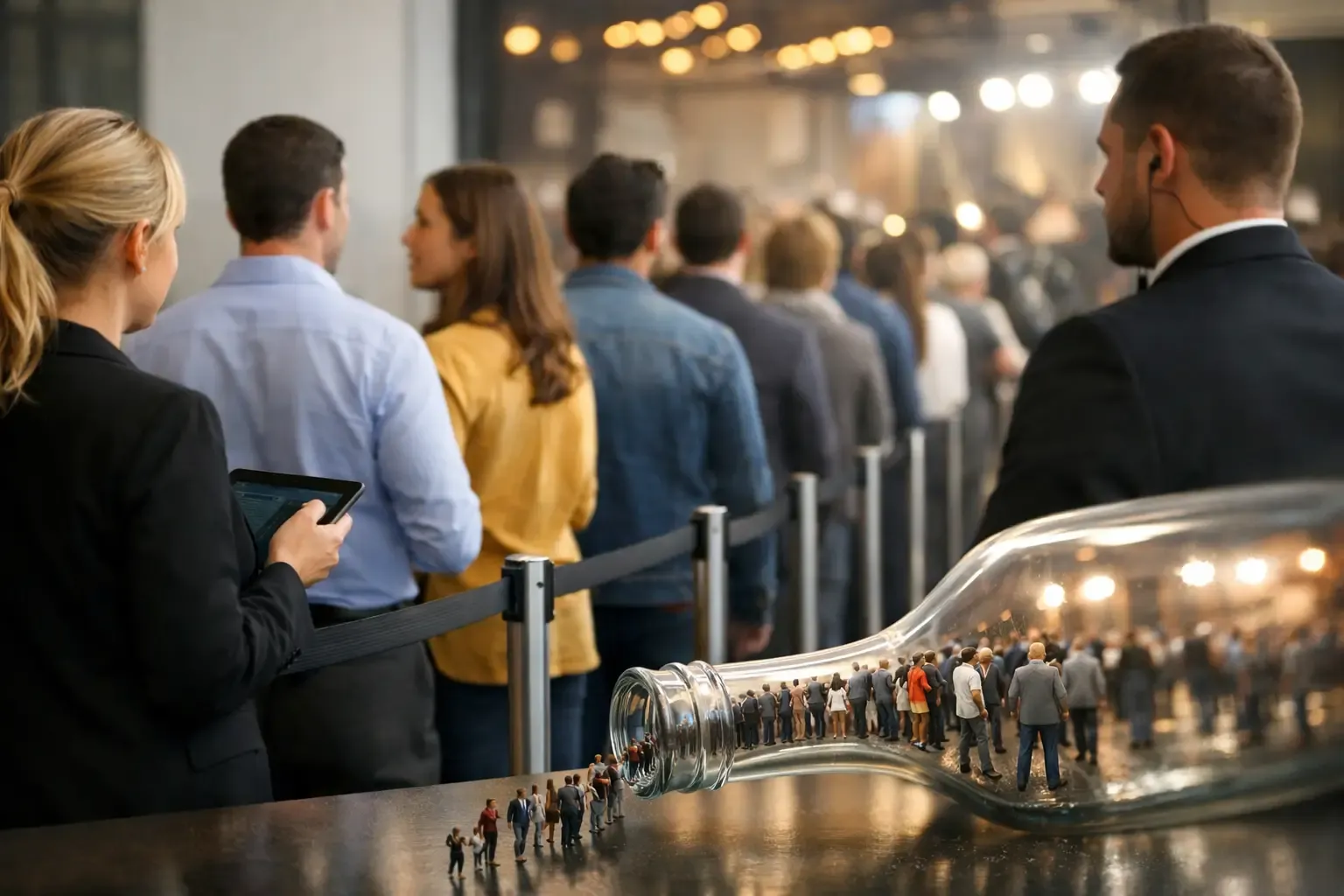
A packed room is not proof that a venue is performing. If guests are waiting 18 minutes for a first drink, standing in a congested entry line, or abandoning a food order because pickup is unclear, volume is exposing an operational weakness. Knowing how to fix venue bottlenecks means finding where demand is getting trapped, then changing the system instead of asking the team to simply work harder.
The costly bottlenecks are rarely dramatic. They show up as slower turns, lower check averages, comped drinks, overtime, negative reviews, and managers spending every peak period putting out the same fires. A good operation does not eliminate every wait. It controls the wait, keeps it moving, and ensures the guest understands what happens next.
Start With the Actual Constraint, Not the Loudest Complaint
Operators often blame the visible queue. The host stand has a line, so they add a host. The bar has guests waiting, so they add another bartender. Sometimes that works. Often, it moves the congestion one station downstream.
The right question is: where does work stop moving at the pace demand requires? In a restaurant, the apparent bar delay may begin with a glassware shortage, an inefficient well setup, slow payment processing, or servers entering drink orders in batches. In an entertainment venue, a long entry line may be driven by bag checks, ticket scanning, ID verification, wristband application, or a poorly positioned security checkpoint.
Track the guest and the order through the full process during a real rush. Do not rely on a walkthrough at 3:00 p.m. when the building is quiet. Observe a Friday night, a sold-out show, a holiday weekend, or the specific service period that creates pressure.
For each step, document three things: how long it takes, how often it pauses, and what causes the pause. Time stamps from the POS, reservation platform, ticketing system, kitchen display system, and payroll data can support the observation, but they do not replace watching the floor. The floor tells you why the numbers are happening.
Map the Guest Journey Before You Redesign the Room
A venue bottleneck is usually a handoff problem. Guests move from parking to entry, entry to check-in, check-in to seating or a service area, ordering to payment, and payment to exit. Staff move through a separate but overlapping path involving storage, prep, production, service, bussing, and reset.
When those paths conflict, speed drops. A barback crossing the guest queue to reach ice, servers cutting through a pickup area, and security personnel blocking the only path to restrooms all create friction that compounds during peak volume.
Map both paths on a basic floor plan. Mark doors, queues, service stations, POS terminals, ice wells, glassware, expo, restrooms, pickup shelves, staging zones, and points where staff must turn, cross, or wait. Then look for two conditions: high-volume tasks happening in tight spaces, and tasks requiring people to cross each other’s route.
The fix may be a layout change, but not always. Moving a printer, relocating to-go staging, changing the direction of a line, or assigning one service corridor for staff can improve flow without a construction project. Larger redesigns make sense when the underlying footprint cannot support the revenue target. That is where layout planning should be tied to forecasted volume, not personal preference.
Protect High-Value Revenue Paths
Not every line deserves equal attention. A queue at a merchandise counter may be frustrating, but a queue that prevents guests from buying their second round during a 90-minute event has a direct and immediate revenue impact.
Rank constraints by what they cost: lost transactions, delayed table turns, labor inefficiency, guest abandonment, or safety exposure. In many venues, the highest-value improvements involve entry throughput, bar production, food pickup, and payment speed because those moments directly affect spend and capacity.
Build Peak-Period Staffing Around Tasks
A staffing schedule based only on total sales or historical labor percentages can miss the operational reality. Two shifts with the same sales total can need very different labor deployment. One may have a steady dining curve; the other may have 500 guests arriving within 30 minutes before a concert.
Staff the work, not just the headcount. Break down the peak period into critical tasks: checking IDs, scanning tickets, seating, taking first drink orders, producing high-volume cocktails, running food, clearing tables, processing payments, resetting stations, and managing the exit.
Then assign ownership. If everyone is responsible for an overloaded task, no one is. A bartender should not be leaving the well to hunt for backup liquor. A manager should not be the default food runner. A host should not be answering phones during a surge at the door.
Cross-training matters, but it has limits. During a true rush, specialized roles generally outperform a group of employees who are each doing a little of everything. Use cross-trained staff as flex support with clear triggers. For example, when the entry line reaches a defined length, a designated employee moves to ticket scanning. When ticket times exceed the target, a runner shifts to expo support. The trigger should be measurable and understood before service begins.
Simplify the Offer When Demand Is Highest
Complexity is a hidden bottleneck. A 14-step cocktail, an oversized menu, a modifier-heavy ordering process, or a promotion that requires manual verification can all slow production at exactly the wrong time.
This does not mean every venue should reduce its concept to the lowest common denominator. It means the offer must match the service environment. A craft cocktail bar with paced reservations can support more detail than a nightclub serving 1,200 guests between 10:00 p.m. and midnight. A full-service restaurant can maintain a broad menu if the kitchen stations, prep levels, and staffing are built for it.
Create a peak-period version of the operation when appropriate. That may include a focused event menu, batched cocktails where quality permits, pre-set beer and wine stations, limited modifiers, QR ordering for specific zones, or a separate pickup point for fast items. The goal is not to remove hospitality. The goal is to remove avoidable decisions and repeated motions.
Before cutting anything, review contribution margin and sales mix. The slowest item may also be highly profitable and strategically important. If so, change its production method, prep it differently, price it correctly, or offer it through a controlled channel rather than eliminating it outright.
Use Technology to Remove Friction, Not Add It
Technology can improve throughput, but only when it fits the operating model. A mobile ordering platform does not help if guests still need to stand in one crowded pickup line. Additional POS terminals do not fix delays if staff are waiting on a single receipt printer or manager approval. Digital ticketing does not increase entry speed if every guest still needs a manual exception check.
Test the full transaction. Measure the time from order placement to production, handoff, payment, and any required reconciliation. Watch where employees revert to paper, walk to another station, ask for approval, or explain a confusing process to guests.
The best tools reduce touches. They also give managers usable data: order volume by interval, ticket times by station, voids and comps, payment method mix, and staffing performance against demand. If the system produces reports no one reviews before the next schedule is written, it is not serving the operation.
Set Service Standards and Manage Them in Real Time
You cannot manage a bottleneck with vague expectations such as “move faster.” Set operating targets that match the concept. Examples include maximum entry wait, first beverage time, bar ticket time, food ticket time, payment completion time, and table reset time.
Targets create a common language between the floor, kitchen, bar, security, and management team. More importantly, they establish an escalation point. If bar ticket times exceed the standard for two consecutive intervals, the manager responds before guests begin leaving or servers stop selling.
Pre-shift meetings should cover expected volume, known constraints, staffing assignments, item availability, event timing, and the recovery plan. After service, review what broke down and why. Avoid turning this into a blame exercise. The objective is to identify whether the issue was staffing, setup, inventory, training, layout, equipment, or a decision that should have been made earlier.
Fix Venue Bottlenecks Through Controlled Testing
Do not change five variables at once and call the result improvement. Pick one high-impact constraint, establish the baseline, make a targeted change, and measure the outcome over enough comparable shifts to see the pattern.
For example, if beverage production is lagging, test a dedicated barback, a revised well layout, a simplified event cocktail list, or a second service bar. Each option has a different labor cost, capital requirement, and effect on guest experience. A dedicated barback may be the fastest low-cost fix. A second bar may be necessary when the room’s capacity and revenue opportunity justify the investment.
Document the new standard once it works. Build it into opening checklists, station diagrams, training, schedules, and manager audits. Otherwise, the improvement disappears when the strongest manager or most experienced bartender is off.
A bottleneck is useful information. It tells you where the operation has outgrown its current design. Treat that signal with discipline, and each correction can turn a frustrating rush into the kind of controlled volume that protects both guest loyalty and profit.