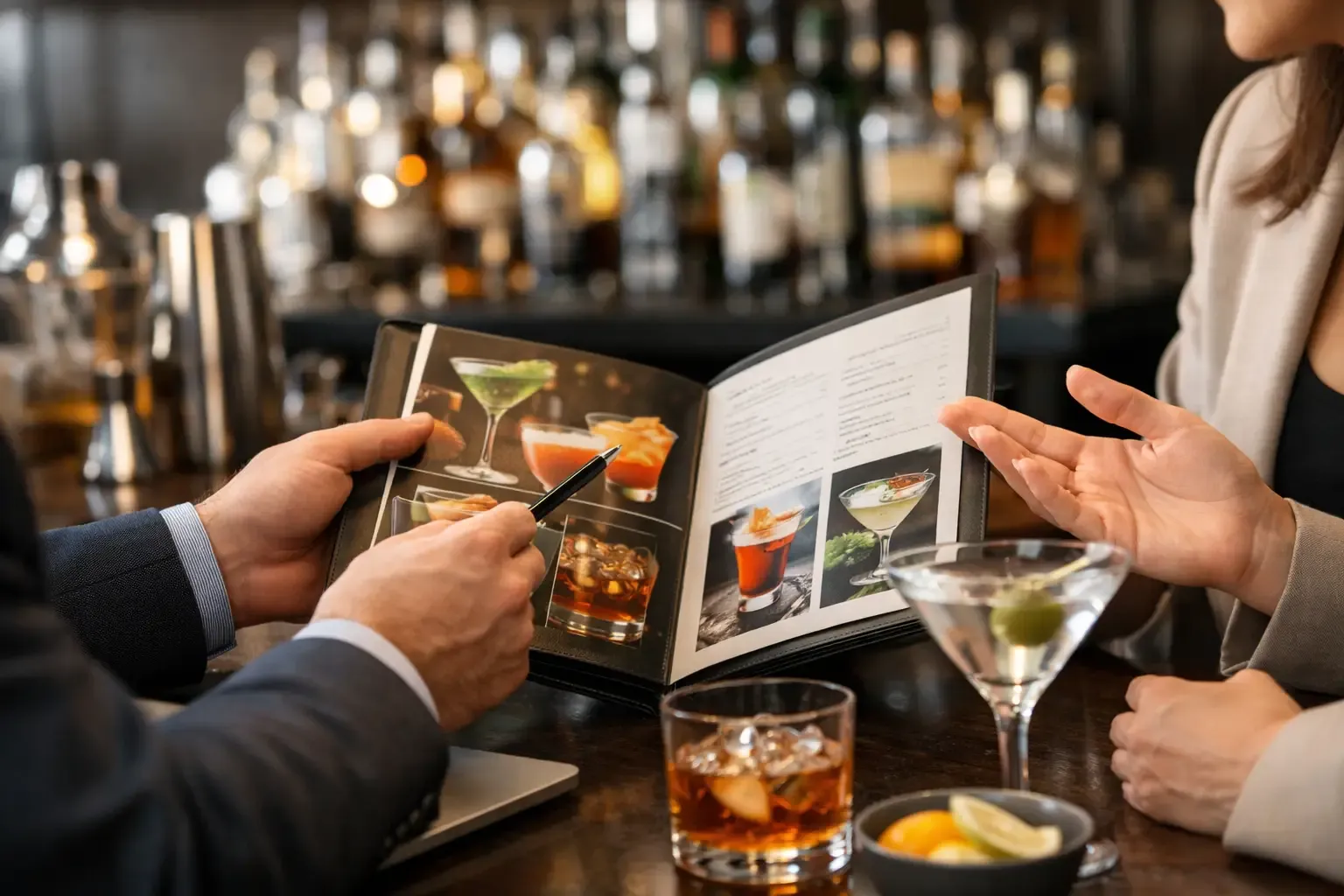
A bar menu can look sharp on paper and still fail where it counts - ticket times, pour cost, staff execution, and repeat orders. That is why bar menu consulting services matter. The real job is not writing clever cocktail names or chasing trends. It is building a beverage program that fits the concept, performs under pressure, and produces margin without slowing the room down.
For operators, that distinction is expensive. A menu with too many low-velocity ingredients ties up cash and creates waste. A cocktail list that requires advanced technique on a lean labor model breaks down on a Friday night. A wine or spirits selection that does not match the guest profile turns inventory into dead stock. Good consulting fixes those problems before they hit the P&L.
What bar menu consulting services should actually deliver
At a practical level, bar menu consulting services should connect brand identity to financial performance. That means concept alignment, recipe development, pricing strategy, inventory logic, and execution standards all working together. If one piece is off, the menu may still launch, but it will not perform consistently.
A serious consulting process starts with the business, not the drinks. Who is the guest? What is the check average target? How fast does the bar need to move during peak volume? What is the labor model? How much storage is available? What is the acceptable beverage cost by category? Those questions shape a profitable menu far more than inspiration boards do.
That is especially true in bars, restaurants, hotels, and entertainment venues where the beverage program has to support a broader operating model. A destination cocktail bar can carry more complexity than a high-volume sports bar. A resort outlet may need broad appeal and flexible daypart coverage. A nightclub may prioritize speed, visual impact, and bottle economics over intricate craft execution. It depends on the concept, the guest, and the operational reality.
The financial case for bar menu consulting services
Most owners do not need a prettier drink list. They need a bar that produces stronger margins, cleaner systems, and better guest uptake. That is where the value sits.
A well-built menu improves sales mix. It steers guests toward high-margin items without making the selling feel forced. It tightens SKU counts, which helps purchasing and reduces waste. It creates sensible cross-utilization, so one syrup, juice, garnish, or spirit can support multiple drinks instead of sitting in the cooler until it expires. It also supports more accurate training because recipes, specs, and prep standards are documented instead of living in one bartender's head.
Pricing is another area where consultants earn their keep. Too many operators price drinks by copying competitors or using a flat multiplier that ignores market position, glassware, labor intensity, and perceived value. Effective pricing accounts for all of it. A premium signature cocktail may support a stronger margin because the guest experience justifies it. A call-brand highball might need a different strategy because it competes more directly on familiarity and speed. There is no single formula that works across every concept.
What a strong consulting engagement looks like
The best engagements are not built around taste alone. They are built around operating conditions.
A consultant should assess the current or planned concept, sales goals, service style, equipment, storage, staffing capability, and licensing constraints before finalizing a menu. Then the work usually moves into beverage category planning, recipe development, costing, pricing, supplier alignment, and implementation standards.
Execution matters as much as design. A menu that looks balanced in a tasting session can still fail during service if recipes require too many touches, too much ice manipulation, or ingredients with inconsistent prep. That is why experienced operators test drinks for batch potential, station flow, garnish speed, and pickup time. They also look at how the menu behaves at volume, not just how it tastes at 2 p.m.
For new concepts, consulting often includes broader decisions such as bar layout, equipment needs, product mix, and opening pars. For existing operations, the focus may be menu engineering, margin repair, underperforming inventory, and staff retraining. The right scope depends on whether the business is launching, repositioning, or trying to fix a beverage program that is already leaking profit.
Where operators usually get it wrong
The most common mistake is designing for aspiration instead of execution. Operators build a menu for the bar they wish they had, with the team they hope to hire, serving the guests they want to attract someday. Then reality shows up. The bar is smaller than expected, the labor pool is thinner, and half the specialty ingredients move too slowly.
Another mistake is overbuilding the cocktail list. More choices do not automatically create more sales. In many cases, they create slower ordering, more training gaps, and a larger prep burden. A tighter menu with clear roles for each drink often performs better than an oversized list filled with internal favorites.
There is also a tendency to treat beverage programming as a creative exercise first and a systems exercise second. That is backward. Creativity matters, but only after the cost structure, service model, and guest expectations are understood. Operators who skip that sequence usually end up rewriting the menu within months.
How bar menu consulting services improve operations
A well-designed menu creates operational discipline. Bartenders know exactly what goes into each drink, managers can spot overpouring faster, and purchasing becomes more predictable. Training becomes easier because recipes are standardized and the menu has a clear sales story.
It also improves guest experience in ways that are easy to miss from the office. Menus become easier to read. Categories make more sense. Signature items feel intentional instead of random. Price points are easier to understand. The staff can recommend with confidence because the lineup is focused and the drinks have a reason to exist.
In high-volume environments, that clarity has a direct impact on throughput. Faster ordering and cleaner specs mean shorter waits and fewer comped drinks from execution errors. In upscale settings, it supports consistency, which matters just as much as creativity. Guests will forgive a simple drink before they forgive an inconsistent one.
When to bring in outside help
Some operators bring in a consultant before opening, which is usually the smartest point to do it. It is cheaper to build the right program from the start than to unwind a bad one after launch. Others wait until signs of strain show up - beverage cost drifting, inventory swelling, staff confusion, slow-moving signature cocktails, or a menu that no longer fits the concept.
Outside help also makes sense during repositioning. If a bar is changing its audience, check average target, service style, or brand identity, the beverage program needs to move with it. The same applies after expansion. A menu that works in one flagship location may not scale cleanly across multiple units without tighter systems and more disciplined product selection.
This is where operator-led firms tend to have an edge. They know that every menu decision affects prep, labor, storage, speed, and financial reporting. Step It Up Strategies approaches beverage work through that lens - not as a branding exercise in isolation, but as part of a larger operating system that has to hold up in the real world.
Choosing the right partner for bar menu consulting services
Not every consultant is built for operating environments. Some are excellent mixologists but weak on financial controls. Others can cost a menu but do not understand guest behavior or brand fit. The right partner can do both.
Look for someone who can explain how menu choices affect cost of goods, labor demands, throughput, and training. Ask how they test for speed and consistency. Ask how they think about cross-utilization, SKU discipline, and pricing ladders. Ask what happens after recipe development. If the answer stops at a spec sheet, the engagement is probably too shallow.
Good consulting should leave you with more than drinks. It should leave you with a beverage program your team can execute, your guests will buy, and your financials can support.
A strong bar menu does not happen because the ideas are exciting. It happens because the menu was built to work when the room is full, the staff is stretched, and every item on the list still needs to earn its place.